Understand MRI Magnet Strength, Image Quality, Safety and Clinical Applications
3T MRI vs 1.5T MRI is a common question for patients who have been advised to undergo an MRI scan. The “T” refers to Tesla, the unit used to describe MRI magnetic field strength. A 3T MRI system has twice the magnetic field strength of a 1.5T system, but that does not mean it is automatically the right choice for every patient or every examination. The appropriate MRI system depends on the body part being examined, the clinical question, scanning protocol, patient factors and radiologist’s interpretation.
What Does 3T Mean in MRI?
The “T” in 3T MRI stands for Tesla, which is the unit used to describe magnetic field strength.
A 3T MRI has a magnetic field strength of 3 Tesla, while a 1.5T MRI has a strength of 1.5 Tesla. Therefore, the magnetic field of a 3T system is twice as strong as that of a 1.5T system.
However, MRI quality cannot be judged by magnet strength alone. Image quality also depends on the MRI equipment, examination protocol, coils, sequence selection, patient positioning and expertise of the radiology team.
3T MRI vs 1.5T MRI: What Is the Main Difference?
The major difference between the two systems is their magnetic field strength.
A higher-field MRI system can provide a stronger signal, which may be used to obtain detailed images or support efficient imaging protocols in appropriate examinations.
| Feature | 1.5T MRI | 3T MRI |
|---|---|---|
| Magnetic strength | 1.5 Tesla | 3 Tesla |
| Image detail | Excellent for many examinations | High detail in many applications |
| Common applications | Broad range of MRI examinations | Particularly useful for many detailed examinations |
| Radiation | No ionizing radiation | No ionizing radiation |
| Patient screening | Required | Required |
| Suitability | Depends on examination and patient | Depends on examination and patient |
The important point is that higher field strength does not automatically make one MRI system suitable for every patient.
Where Can 3T MRI Be Particularly Useful?
A 3T MRI in Surat may be useful for examinations where detailed soft-tissue imaging is important.
Depending on the clinical requirement, 3T MRI can be used for imaging areas such as:
- Brain and nervous system
- Spine
- Knee and shoulder
- Other joints and sports injuries
- Prostate
- Breast
- Abdomen
- Pelvis
The exact MRI protocol should be selected according to the medical question and the patient’s individual circumstances.
Is 3T MRI Better Than 1.5T MRI?
There is no single answer that applies to every examination.
A 1.5T MRI remains a widely used and capable system for many routine and advanced MRI examinations. A 3T MRI can offer advantages in certain applications because of its higher magnetic field strength and potential for increased signal.
Therefore, patients should not select an MRI solely because the machine has a higher Tesla number.
The more important factors include:
Appropriate technology + correct MRI protocol + experienced radiology interpretation.
3T MRI for Brain and Neurological Imaging
The brain contains many small and complex structures that require detailed imaging.
In appropriate neurological examinations, 3T MRI can provide high-resolution images that may help evaluate subtle abnormalities.
Depending on the clinical indication, MRI may be used to assess conditions involving the brain, blood vessels, nerves and other neurological structures.
Your doctor and radiologist can determine whether a 3T or 1.5T examination is appropriate for your particular requirement.
3T MRI for Knee, Shoulder and Sports Injuries
MRI is particularly useful for evaluating soft tissues that may not be clearly visualized on conventional X-rays.
For knee, shoulder and other musculoskeletal examinations, MRI can assess structures such as:
- Ligaments
- Tendons
- Cartilage
- Muscles
- Menisci
- Other soft tissues
A 3T MRI system can be useful for detailed musculoskeletal imaging when the appropriate protocol is selected.
Is 3T MRI Safe?
MRI does not use ionizing X-ray radiation. Both 1.5T and 3T MRI systems use a strong magnetic field and radiofrequency energy to produce images.
However, MRI safety screening is essential.
Before an MRI examination, tell the radiology team if you have:
- A pacemaker or implanted cardiac device
- Metallic implants
- Certain electronic medical devices
- Previous surgery involving metal
- A metallic foreign body
- Any other implanted device
The MRI team will assess the device or implant and determine whether the examination can be performed safely.
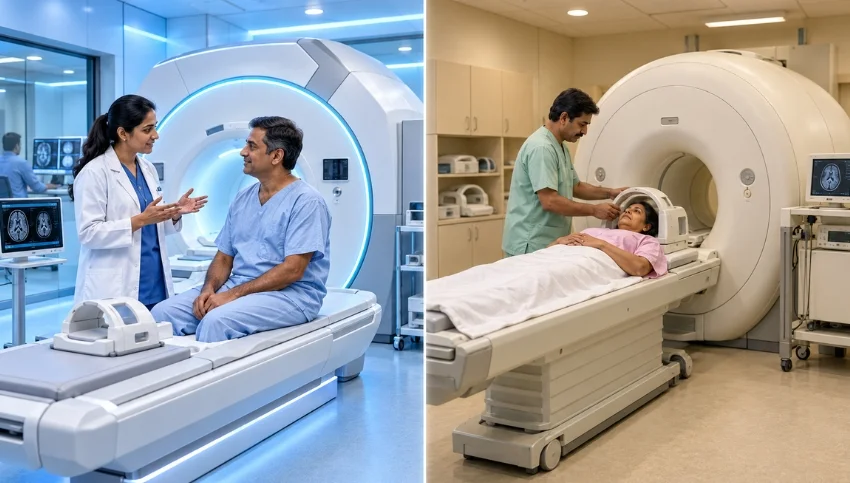
What Does a 3T MRI Feel Like?
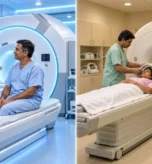
For most patients, the experience is similar to other MRI examinations.
You will lie on an MRI table, which moves into the scanner. During imaging, the machine produces loud tapping, knocking or buzzing sounds.
Hearing protection is normally provided.
The most important thing is to remain as still as possible during image acquisition because movement can affect image quality and may require additional sequences.
What If I Am Claustrophobic?
Some patients feel uncomfortable inside an MRI scanner.
If you experience claustrophobia, inform the imaging centre before your appointment. The radiology team can explain the examination process and discuss available options to make the experience more comfortable.
Following the instructions provided by the MRI team can also help the examination proceed smoothly.
Do I Need a 3T MRI Specifically?
Not necessarily.
If your doctor has recommended an MRI, the appropriate scanner depends on the body part, suspected condition, clinical question and required imaging protocol.
For some examinations, a properly performed 1.5T MRI may provide all the information required. For other examinations, a 3T system may offer useful advantages.
Your doctor and radiologist are best placed to determine which examination is appropriate.
3T MRI in Surat at Super Scan Imaging Centres
3T MRI in Surat is available at Super Scan Imaging Centres for a range of diagnostic applications.
The centre provides MRI examinations for areas including neurological, spine, musculoskeletal, abdominal and pelvic imaging, depending on clinical requirements.
The focus is on selecting appropriate imaging protocols and producing diagnostic-quality images that can assist doctors in evaluating a patient’s condition.
If you have been advised to undergo an MRI and are unsure whether a 3T MRI Scan or 1.5T MRI is appropriate, discuss your requirement with your doctor or the radiology team before scheduling the examination.
Frequently Asked Questions
1. Is 3T MRI twice as good as 1.5T MRI?
No. A 3T MRI has twice the magnetic field strength of a 1.5T system, but diagnostic quality depends on several factors, including the equipment, protocol, examination and radiologist’s interpretation.
2. Does 3T MRI use more radiation?
No. MRI does not use ionizing radiation. Both 1.5T and 3T MRI use magnetic fields and radiofrequency energy.
3. Is 3T MRI useful for brain scans?
Yes. 3T MRI can provide detailed images and may be particularly useful for various neurological examinations when clinically appropriate.
4. Is 3T MRI useful for knee and shoulder problems?
It can be useful for detailed evaluation of joints and soft-tissue structures such as cartilage, ligaments and tendons.
5. Is 1.5T MRI still useful?
Yes. 1.5T MRI remains widely used for many types of MRI examinations and can provide excellent diagnostic information when the appropriate protocol is used.
6. Do I need a doctor’s recommendation for MRI?
MRI should generally be performed based on appropriate medical advice so that the correct body part, protocol and clinical indication can be considered.