Understand CT scan and Radiation, potential risks, radiation-dose differences, child safety and how doctors balance diagnostic benefits with unnecessary exposure.
CT Scan and Radiation are important topics for patients who are preparing for a CT examination. A CT scan uses X-rays to create detailed images of the inside of the body, so understanding radiation exposure, possible risks and safety measures is essential. When a CT scan is medically necessary, its diagnostic benefits may outweigh the potential risks. The decision should always be based on the patient’s condition and the medical information the scan is expected to provide.
What Is CT Scan Radiation?
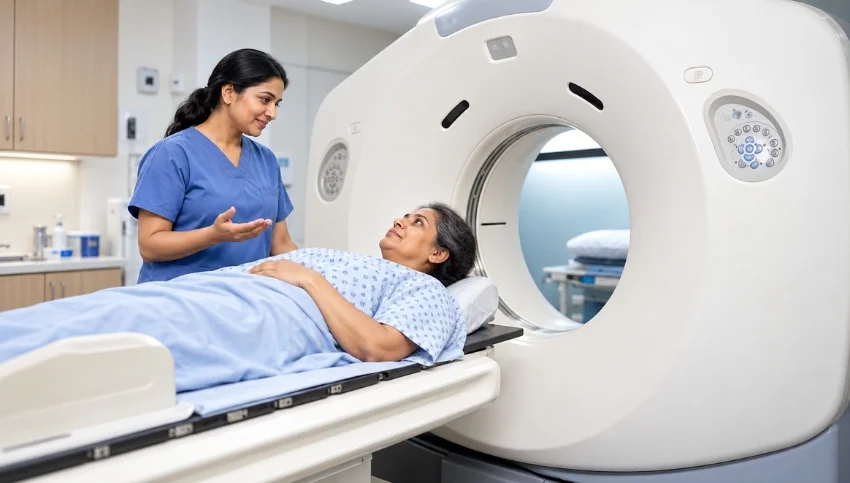
Computed Tomography (CT) uses X-rays taken from multiple angles and computer processing to produce detailed cross-sectional images of internal structures. These images can help doctors assess organs, lungs, blood vessels, bones and other parts of the body.
Unlike ultrasound and MRI, CT uses ionizing radiation. Its detailed images can be valuable when a doctor needs to investigate an injury, assess a medical condition or guide treatment decisions.
A CT scan should be selected according to the clinical question it needs to answer—not simply because the technology is available.
Does Every CT Scan Use the Same Radiation Dose?
No. CT scan radiation dose varies from one examination to another. It depends on several factors, including:
- The body part being examined, such as the head, chest or abdomen.
- The patient’s age, size and clinical needs.
- The type and complexity of the CT examination.
- The scanner and the imaging protocol selected by the clinical team.
- Whether additional scan phases are medically necessary.
For this reason, there is no single radiation-dose figure that applies to every CT scan. If you have concerns about the expected dose for your examination, ask your doctor or imaging team to explain the procedure and why it has been recommended.
Can Radiation from a CT Scan Increase Cancer Risk?
Ionizing radiation can potentially increase the lifetime risk of cancer. The potential risk depends on factors such as radiation dose, age and cumulative exposure. For an individual medically appropriate CT examination, the potential added risk is generally considered small, but it is not zero.
The decision should balance the possible radiation risk against the benefit of obtaining information needed to diagnose or manage a health problem.
A CT scan may help doctors identify conditions that need prompt attention. Avoiding a medically necessary scan purely out of fear can delay diagnosis or treatment. On the other hand, a CT scan should not be performed without a sound clinical reason.
The important question is not only whether a CT scan uses radiation, but whether the examination is appropriate for your medical situation.
Should You Avoid Repeated CT Scans?
Not necessarily. Some patients need more than one CT examination to investigate a condition, monitor treatment or assess changes over time. In these cases, repeat imaging may be clinically justified.
However, unnecessary repeat scans should be avoided. To help your doctor and radiologist make an informed decision:
- Share details of previous CT scans and other relevant imaging.
- Bring previous reports and images when available.
- Tell your doctor if you have recently undergone similar examinations.
- Ask whether an earlier scan can answer the current clinical question.
- Discuss whether MRI, ultrasound or another suitable examination could provide the required information.
The aim is to perform the right examination when it is needed, while avoiding unnecessary radiation exposure.
Is CT Scan Radiation More Concerning for Children?
Children require particular care because their bodies are still developing and they generally have a longer lifetime ahead in which potential radiation effects could emerge. Their CT examinations should therefore be carefully justified and adjusted to their size and clinical needs.
When a child needs a CT scan, the imaging team should use an appropriate pediatric protocol and the lowest radiation dose that can provide images adequate for diagnosis.
Parents can ask the treating doctor why CT is recommended, whether an alternative examination is suitable and how the scan settings will be adjusted for the child.
A necessary CT scan should not automatically be withheld from a child when it is the appropriate examination for an important medical question. The decision should be made with the treating clinician.
Can MRI or Ultrasound Replace a CT Scan?
Sometimes, but not in every situation. MRI and ultrasound do not use ionizing radiation, and they can be excellent choices for many clinical questions. However, different imaging tests provide different types of information.
- CT scan: Can be useful for certain emergencies, injuries, lung conditions, kidney stones and selected abdominal or vascular assessments.
- MRI: Uses magnetic fields and radio waves, and may be preferred for selected brain, spine, joint and soft-tissue examinations.
- Ultrasound: Uses sound waves and can be useful for assessing many abdominal, pelvic, vascular and pregnancy-related conditions.
The most appropriate examination depends on your symptoms, medical history and the question your doctor needs answered. The test with no ionizing radiation is not automatically the best test for every condition.
How Is Radiation Exposure Reduced During a CT Scan?
Radiation protection in CT imaging focuses on using the lowest dose that can still produce images suitable for the diagnostic purpose. This principle is commonly associated with keeping exposure “As Low As Reasonably Achievable” (ALARA).
Dose optimization may include:
- Selecting a CT examination only when clinically justified.
- Choosing scan settings appropriate for the patient and body region.
- Using patient-size-appropriate protocols, especially for children.
- Limiting the scanned area to what is required.
- Avoiding additional scan phases unless they are clinically necessary.
- Reviewing previous imaging to reduce avoidable repeat examinations.
Modern CT systems may include dose-management features, but the actual radiation dose still varies according to the examination, patient and protocol. No responsible imaging provider should promise that a CT scan has zero radiation or zero risk.
What Should You Tell Your Doctor Before a CT Scan?
Before your examination, tell your doctor or imaging team if:
- You are pregnant or think you might be pregnant.
- You have had similar imaging examinations recently.
- You have questions about the need for the scan or possible alternatives.
- You have any specific medical concern that may affect how the examination is planned.
If your CT examination requires contrast material, additional questions may apply—for example, about previous contrast reactions or kidney-related concerns. Follow the preparation instructions provided for your specific examination, and do not stop prescribed medicines unless your doctor tells you to.
Frequently Asked Questions
1. Is CT scan radiation dangerous?
CT scans use ionizing radiation, which can carry a small potential long-term risk. When a scan is medically justified, the expected diagnostic benefit is weighed against that risk. Your doctor can explain why the examination is appropriate for you.
2. Does a CT scan always cause cancer?
No. Having a CT scan does not mean a person will develop cancer. Radiation exposure can potentially increase lifetime cancer risk, but the additional risk from an individual medically appropriate examination is generally considered small.
3. Is a CT scan safe for children?
A CT scan may be appropriate for a child when it is needed to answer an important medical question. The examination should be justified, and the protocol should be adjusted for the child’s size and clinical needs.
4. Can I ask for a low-radiation CT scan?
You can ask the referring doctor or imaging team how radiation exposure is optimized for your examination. The protocol must still provide images of sufficient quality to answer the medical question.
5. Should I avoid CT scans if I have had one before?
Not automatically. Previous imaging should be considered, but another scan may be necessary if it provides important information for diagnosis or treatment. Your doctor should assess the clinical need and available alternatives.
6. Is MRI safer than CT because it has no radiation?
MRI does not use ionizing radiation, but it is not a direct replacement for every CT examination. The best test depends on the medical question, and each modality has its own benefits, limitations and precautions.
7. Where can I enquire about a CT scan in Surat?
You can contact Super Scan in Surat to enquire about CT scan services, appointment requirements and preparation instructions. Your doctor should determine which examination is appropriate for your condition.